
Vertically Fractured or Cracked Teeth
Just about everyone has a friend that will tell you that he or she had a root canal done with a crown and then lost the tooth shortly thereafter. I have patients come in frequently who say that they are afraid that if they get a root canal, they will lose the tooth because root canals don’t last!
While root canal treatments are highly successful, Chat GPT indicates 90-97% success rate for “Short Term Success” (1 to 3 years) and 85-90% for “Long Term Success (5-10+ years). In my opinion we are probably closer to about 80% overall. I see plenty of patients with root canal treatments that were done 40+ years ago that are still in function and the patient is asymptomatic…and still has the tooth/teeth. I also see patients with beautifully done root canal treatments only a few months old with abscesses and pain.
So what’s going on?
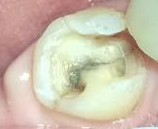
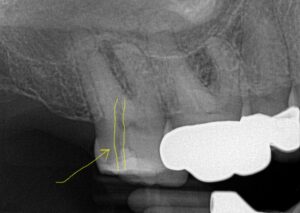
I believe the story that your friends tell you or that you may have experienced yourself is due to improperly diagnosed or missed Vertical Fractures. Sometimes they get missed. It happens to the best of us so I’m not disparaging other dentists out there. These are fractures which are basically up and down the straight axis of the root like the one in the x-ray below. In my opinion and anecdotally from what I have seen in my 36 years of being a dentist, these fractures DO NOT HEAL no matter how well done a root canal procedure was performed. By vertical fractures, I mean fractures that either start in the (clinical) crown of the tooth, the part that is visible above the gum line, and continue onto/into the root below the gum line or one that begins in the root without the crown being involved, and here is where it gets tricky. Some teeth which are for lack of a better word, cracked but the crack does not appear to extend below the gum line may have a good chance of survival with just a crown if they are not symptomatic or are not very symptomatic when chewing. Someone saying that they experience a 4 or more on a 0 to 10 pain scale most likely has a non-salvageable tooth as the crack has already extended into the pulp or what people refer to as the nerve.
So with these teeth a crown is usually recommended if the discomfort or sensitivity (which is still pain just at a lower level or someone intentionally trying to divert a dentist’s attention away from the severity they are feeling because they don’t want to hear bad news or face the news which is coming) is a 3 or less. With some of these teeth, the crack or vertical fracture has already extended below the gum line but cannot be seen at t his particular time and these teeth will wind up getting extracted. I get nervous when I hear dentists refer to teeth as having “cracked tooth syndrome” and their need for a crown since I know many of these teeth are actually vertically fractured and will require extraction. At this point, if the crack does not appear to extend below the gum line and the tooth has sensitivity of 3 or less or is asymptomatic, I would inform the patient as to their options. Earlier in my career, I went along with the whole “cracked tooth syndrome” idea and would crown the tooth which would invariably become painful weeks or months later, then perform root canal treatment and then finally extract the tooth which was NOT a practice builder for rather obvious reasons.
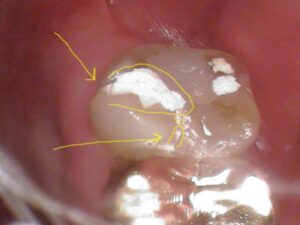
Diagnosis is the key; however, some cracks just don’t lend themselves to easy interpretation so they will be missed even by practitioners attempting to do the best for their patients and a tooth will be lost after root canal treatment, a buildup including maybe a post and a crown sometimes in short order as in less than a year. I have heard other colleagues who do not have CBCT capability say “Well just take a CBCT.” CBCTs, dental CAT Scans, are great but they are not high resolution images and, in my experience, rarely show fine cracks or fractures but show radiolucencies (abscesses) in areas which are highly suggestive of cracks or fractures. Those practitioners with CBCT capability typically charge $500 or more for the 3D images. This becomes impractical for many people so taking a CBCT on everyone tends to get out of hand when the percentages for a diagnosis that is very close tend to work in favor of the patient so a CBCT is generally taken only when things look pretty good on an X-ray and yet there are symptoms (pain or mobility) in a general practitioner’s office and perhaps in many Endodontists’ offices (root canal specialists). They tend to be taken also on what I call “Mission Critical Teeth” as in teeth which would be very difficult to restore otherwise if the root canal treatment fails and the patient desires to have a tooth present in a certain site.
So in closing, teeth which are obviously vertically fractured or cracked and those fractures extend below the gum line are NOT SALVAGEABLE and require extract and replacement. Teeth with through and through fractures into the pulp/nerve are also not salvageable but those patients generally know this already and request the extraction. There will be, however, some teeth which slip through the diagnostic process and will receive a root canal treatment and a crown. I believe that most practitioners did not plan this and are well meaning but the outcome was not was planned and it has happened to just about every dentist. This has happened to me from time to time and it is always an unpleasant conversation but even with the best intentions, it happens. So why don’t we just extract every tooth and place an implant and just bypass the root canal altogether? I personally think that’s a bit aggressive since I try to use what nature gave us first if there is a good chance of success. Implants can have their own set of problems so I use them as a last resort unless the situation calls for one.
Feel free to ask me any questions you have about this topic. There are always shades of grey and we can all learn from our experiences.
