A missing tooth can change more than your smile. It can make meals less enjoyable, affect how you speak, and allow neighboring teeth to shift over time. When comparing a dental bridge versus partial denture, the best choice is not simply the one that replaces the visible space. It is the option that supports your comfort, oral health, confidence, and daily routine.
Both restorations can be excellent solutions for replacing one or more teeth. The right recommendation depends on where the teeth are missing, the health of nearby teeth and gums, your bite, your goals, and how you feel about removable dental appliances. A thoughtful exam allows your dentist to look beyond the gap and create a plan designed around you.
What Is a Dental Bridge?
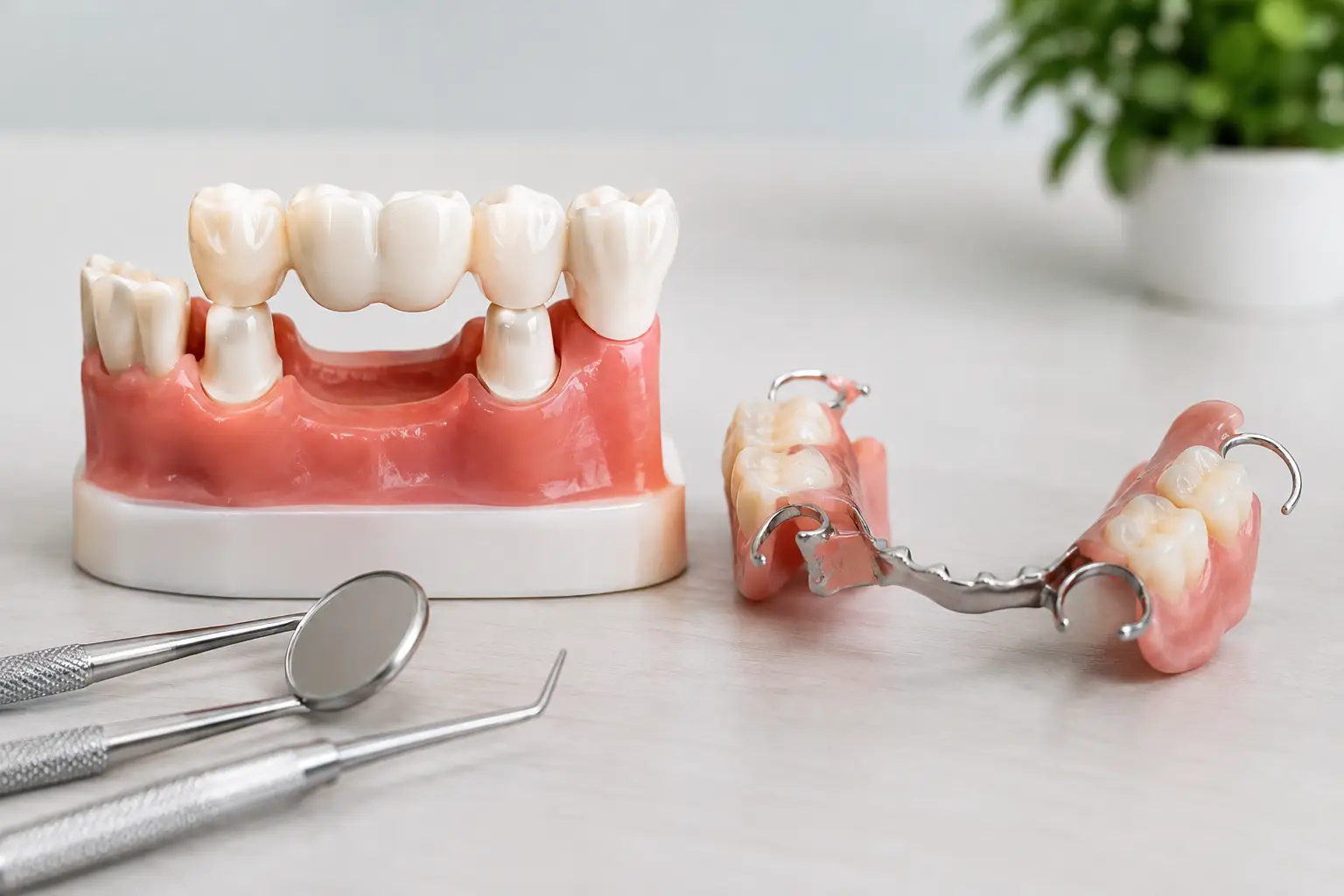
A dental bridge is a fixed restoration that fills the space left by one or more missing teeth. In a traditional bridge, crowns are placed on the healthy teeth on either side of the gap. Those crowns support the replacement tooth or teeth between them, creating a secure, natural-looking restoration.
Because a bridge is cemented in place, it does not come out for cleaning or sleeping. Most patients find that it feels more like having natural teeth than a removable appliance. You brush it normally, although cleaning underneath the replacement tooth requires a special floss threader, interdental brush, or water flosser.
A bridge can be a strong option when the teeth beside the open space already need crowns because of large fillings, fractures, or significant wear. It can restore chewing ability and help keep adjacent teeth from drifting into the empty area.
What Is a Partial Denture?
A partial denture is a removable appliance made to replace several missing teeth, or teeth in different areas of the mouth. It may have a lightweight acrylic base, a metal framework, or flexible materials that blend with the gums. Replacement teeth are custom arranged to support a natural appearance and bite.
Some partial dentures use small clasps around existing teeth for support. Others use more discreet precision attachments, depending on the design and the condition of the remaining teeth. You remove a partial denture for cleaning and usually at night, following your dentist’s instructions.
Modern partial dentures can be much more comfortable and natural-looking than many people expect. Still, there is an adjustment period. Your tongue and cheeks need time to adapt, and the appliance may initially feel bulky or affect speech slightly. Careful adjustments can make a meaningful difference in comfort.
Dental Bridge Versus Partial Denture: Key Differences
The most noticeable difference is that a bridge is fixed and a partial denture is removable. That distinction affects everything from daily care to how each option feels while eating.
Comfort and stability
A fixed bridge is generally more stable during meals and conversation because it is attached to supporting teeth. Many patients prefer the security of not having to remove it. A partial denture can also fit securely, but it rests on the gums and relies on remaining teeth for support. It may move slightly with certain foods, particularly if the fit changes over time.
Comfort is personal. A well-designed partial denture can be a practical, comfortable answer for someone missing multiple teeth. A bridge may feel more familiar for a patient replacing a single tooth or a short span of teeth. If dental anxiety has kept you from seeking care, remember that treatment can be paced around your needs, with comfort options available for more involved procedures.
Appearance
Both options can be made to complement the color, shape, and character of your natural teeth. A bridge often offers a very natural appearance because it is permanently positioned and individually designed. A partial denture can also look attractive, especially when teeth are carefully matched and clasps are placed thoughtfully.
The location of the missing tooth matters. For a visible front tooth, appearance may be a primary concern. For back teeth, chewing function and the condition of the supporting teeth may carry more weight in the decision.
Effect on nearby teeth and bone
A traditional bridge requires shaping the teeth next to the gap so they can receive crowns. This is not necessarily a drawback when those teeth already need protection, but it deserves consideration when neighboring teeth are completely healthy.
A partial denture typically requires less alteration to adjacent teeth. However, its clasps and movement can place pressure on the teeth and gums that support it. Regular checkups are essential to monitor those areas.
Neither a conventional bridge nor a traditional partial denture replaces the tooth root. That means neither prevents bone loss in the jaw as effectively as a dental implant can. For some patients, implant-supported bridges or implant-supported dentures may offer greater stability and help preserve bone. Not every patient is a candidate immediately, but it is worth discussing as part of a long-term plan.
Cleaning and maintenance
A bridge stays in place, so daily hygiene focuses on brushing thoroughly and cleaning beneath the artificial tooth. Food debris and plaque can collect under a bridge if that area is overlooked. Consistent home care and professional cleanings help protect the supporting teeth and gums.
A partial denture must be removed and cleaned daily with products appropriate for dental appliances. It should not be cleaned with hot water, which can distort some materials. Your natural teeth, gums, and the appliance itself all need regular attention. A partial denture may also need adjustments or relining as your gums and bone naturally change over the years.
Cost and longevity
The initial cost of a bridge is often higher than that of a partial denture, though treatment costs vary based on the number of teeth involved, materials used, and any care needed beforehand. A partial denture may be a more accessible starting point when several teeth are missing or when a patient needs to replace teeth in multiple locations.
With excellent care, a bridge can serve for many years. Its longevity depends heavily on the health of its supporting teeth and gums. Partial dentures can also last for years, but they commonly need periodic adjustments, repairs, or replacement as the mouth changes. The lowest upfront cost is not always the lowest long-term cost, so it helps to consider future maintenance as well as today’s budget.
When a Bridge May Be the Better Fit
A bridge may be especially appropriate when you are missing one tooth or a short sequence of teeth, have strong neighboring teeth, and want a fixed solution without a surgical procedure. It can also be an efficient choice if adjacent teeth need crowns anyway.
Your dentist may advise against a bridge if the supporting teeth are weak, if gum disease is not controlled, or if the span is too long for predictable support. Bridges work best when the foundation is healthy.
When a Partial Denture May Make More Sense
A partial denture can be a sensible option when several teeth are missing, particularly when they are not all next to one another. It may also be recommended when a bridge would require extensive work on healthy teeth or when a more conservative initial investment is preferred.
A partial denture can sometimes serve as an interim solution while you prepare for implants or other restorative treatment. That does not make it a lesser choice. It can be an effective long-term restoration when it is properly designed, adjusted, and cared for.
The Questions That Lead to a Confident Decision
Rather than choosing solely by price or what worked for a friend, ask how each option will affect your specific mouth. Consider whether you want a removable or fixed restoration, what condition the neighboring teeth are in, how many teeth need replacement, and whether preserving jawbone with implants is a priority.
It is also reasonable to ask what the treatment will feel like, how long it will take, and what comfort options are available. For patients who feel anxious about dental procedures, clear explanations and a calm, compassionate approach can make it easier to move forward with needed care.
At Art of Smiles, treatment planning begins with listening. A comprehensive evaluation can clarify whether a bridge, partial denture, implant option, or another approach best supports your health and the smile you want to share. The next useful step is simply a conversation – one that leaves you informed, comfortable, and in control of your care.
