If you are weighing all on 4 vs traditional implants, you are probably not just comparing procedures. You are trying to picture your life afterward – how you will eat, smile, heal, and feel in the dental chair. That decision deserves more than a quick pros-and-cons list. It deserves a clear explanation of what each option is designed to do and which one truly fits your needs.
For some patients, the right answer is speed and full-arch efficiency. For others, it is a more customized tooth-by-tooth approach. Both options can be life-changing. The difference is in how much tooth loss you have, the condition of your jawbone, your timeline, and your comfort level with treatment.
All-on-4 vs traditional implants: what is the difference?
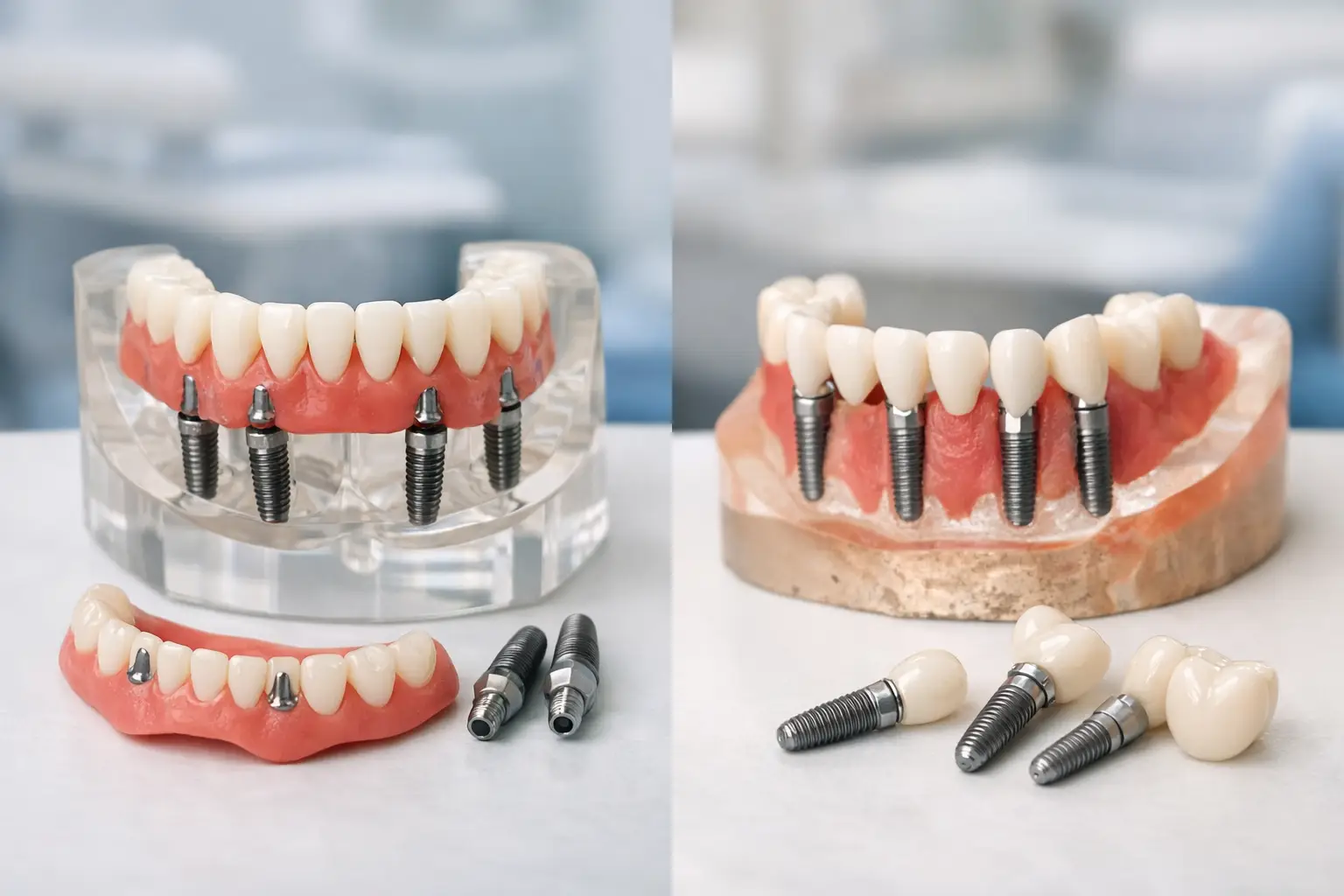
The biggest difference is what each treatment is built to replace. All-on-4 is designed for people who need to replace a full upper arch, a full lower arch, or both. Instead of placing an implant for every missing tooth, four strategically placed implants support a full arch of replacement teeth.
Traditional implants are usually used to replace one missing tooth, several missing teeth, or sometimes a full arch with a greater number of implants. In that case, each implant may support an individual crown, a bridge, or a larger denture-style restoration.
So while both treatments use implants anchored in the jawbone, they are not interchangeable in every situation. One is often a full-arch solution. The other is often a more segmented or highly individualized restoration plan.
Who is usually a better fit for All-on-4?
All-on-4 often makes sense for patients who are missing most or all of their teeth, have failing teeth that need to be removed, or are tired of dealing with loose dentures. It can also be a strong option for people who want a more streamlined treatment plan.
One reason patients are drawn to All-on-4 is efficiency. With careful planning, it is often possible to remove failing teeth, place implants, and deliver a fixed temporary arch in a shorter timeframe than many people expect. That can be especially meaningful if you are embarrassed by your smile or frustrated by a denture that shifts when you talk or eat.
Another advantage is that All-on-4 can sometimes work well even when bone volume is limited. Because the back implants are often angled strategically, some patients can avoid more extensive grafting procedures. That does not mean grafting is never needed, but it can make care more accessible for patients who have already experienced bone loss.
When traditional implants may be the better choice
Traditional implants are often ideal when you are missing only one tooth or a few teeth and the surrounding teeth are healthy. In that situation, replacing each missing tooth individually can preserve a very natural feel and function without involving a full-arch prosthetic.
They may also be the better choice if you want the most customized replacement possible for specific spaces in your smile. If your bone support is good and your oral health is stable, individual implants can provide excellent long-term results.
For some full-mouth cases, traditional implant treatment with more implants may also be recommended when maximum support, bite distribution, or prosthetic design calls for it. This is where a detailed exam matters. The best treatment is not always the one with fewer implants. It is the one that best matches your anatomy and long-term goals.
Comparing comfort, surgery, and recovery
Patients often assume more implants automatically means a more difficult experience. That is not always true, but treatment complexity does affect healing, appointments, and planning.
All-on-4 can feel simpler from a patient perspective because it is designed to solve a large problem with a more consolidated approach. If you need full-arch restoration, having one coordinated treatment plan may feel more manageable than a series of individual implant procedures.
Traditional implants can be a very straightforward experience when only one or two teeth are being replaced. But if many teeth are missing across the mouth, the process may involve multiple implant placements, possible grafting, and staged restorative work over time.
Comfort during treatment matters just as much as the surgical plan. For patients with dental anxiety, that can be the deciding factor in whether they move forward at all. A practice that offers advanced comfort options, clear communication, and sedation when appropriate can make a major difference in how treatment feels from start to finish.
All-on-4 vs traditional implants: healing time and timeline
Healing is one area where expectations need to be realistic. Implants of any kind need time to integrate with the bone. That biological process does not happen overnight.
With All-on-4, patients are often excited by the possibility of leaving with a fixed temporary set of teeth the same day or soon after surgery. That immediate transformation is a major benefit. Still, the final restoration usually comes later, after healing and tissue stabilization.
With traditional implants, the timeline depends heavily on the number of implants, whether extractions are needed, and whether bone grafting is part of treatment. A single implant can be relatively simple. A larger reconstruction may take longer than patients expect.
So if your top priority is avoiding a removable denture and getting to a functional smile quickly, All-on-4 may have an advantage. If your needs are more limited and localized, traditional implants may offer a direct and efficient path.
What about appearance and chewing strength?
Both treatments can look excellent when they are planned well. The difference is in the style of restoration.
Traditional implants with individual crowns often mimic natural teeth very closely because each tooth is restored separately. This can be especially appealing when replacing front teeth or a few missing teeth in a smile zone where detail matters.
All-on-4, on the other hand, restores an entire arch as one connected prosthesis. When done well, it can create a beautiful, balanced smile and dramatically improve facial support and confidence. For patients coming from severe tooth loss or unstable dentures, the visual change can be remarkable.
Chewing function also improves with both options, but expectations should be personalized. Individual implants can feel very natural for isolated tooth replacement. All-on-4 can restore strong full-arch function, but the materials, bite forces, and maintenance plan all play a role in long-term performance.
Cost is important, but value matters more
It is reasonable to ask about cost. Most patients do. But the better question is what kind of treatment gives you the best value for your specific situation.
If you need to replace a single tooth, traditional implants are usually the more logical financial choice. It would not make sense to consider All-on-4 for a small gap.
If you need to replace an entire arch, All-on-4 may be more efficient than placing a larger number of traditional implants across that arch. Fewer implants, fewer procedures in some cases, and a more streamlined restoration plan can affect overall cost.
That said, the cheapest option is not always the most affordable over time. A treatment that fits well, functions well, and is designed around your long-term oral health may save stress, time, and additional dentistry later.
The role of bone loss, gum health, and overall health
This is where online comparisons often fall short. They make it sound as though choosing between treatments is mostly about preference. In reality, your existing oral health may narrow the field.
Significant bone loss, active gum disease, untreated infection, and certain medical conditions can all influence what is possible and what needs to happen first. Some patients are candidates for either option. Others are much better suited to one approach.
That is why a proper exam, imaging, and treatment discussion matter so much. A doctor needs to evaluate not just the teeth you are missing, but the health of the bone and gums that would support your restoration.
Which option feels right for most anxious patients?
For anxious patients, the best choice is often the one that combines the right clinical plan with the right level of support. A technically excellent treatment does not help much if fear keeps you from starting.
Many patients feel more at ease when their care is explained clearly, broken into manageable steps, and performed in a setting that prioritizes comfort. At Art of Smiles, that comfort-centered approach is especially meaningful for patients considering advanced restorative care, because confidence in the process can be just as important as confidence in the result.
If you are deciding between All-on-4 and traditional implants, the right next step is not guessing. It is getting a personalized evaluation from a team that will explain your options honestly, answer your questions patiently, and help you choose a solution that supports both your health and your peace of mind. The best smile replacement is the one that fits your life well enough that you can finally stop thinking about your teeth and get back to living.
